
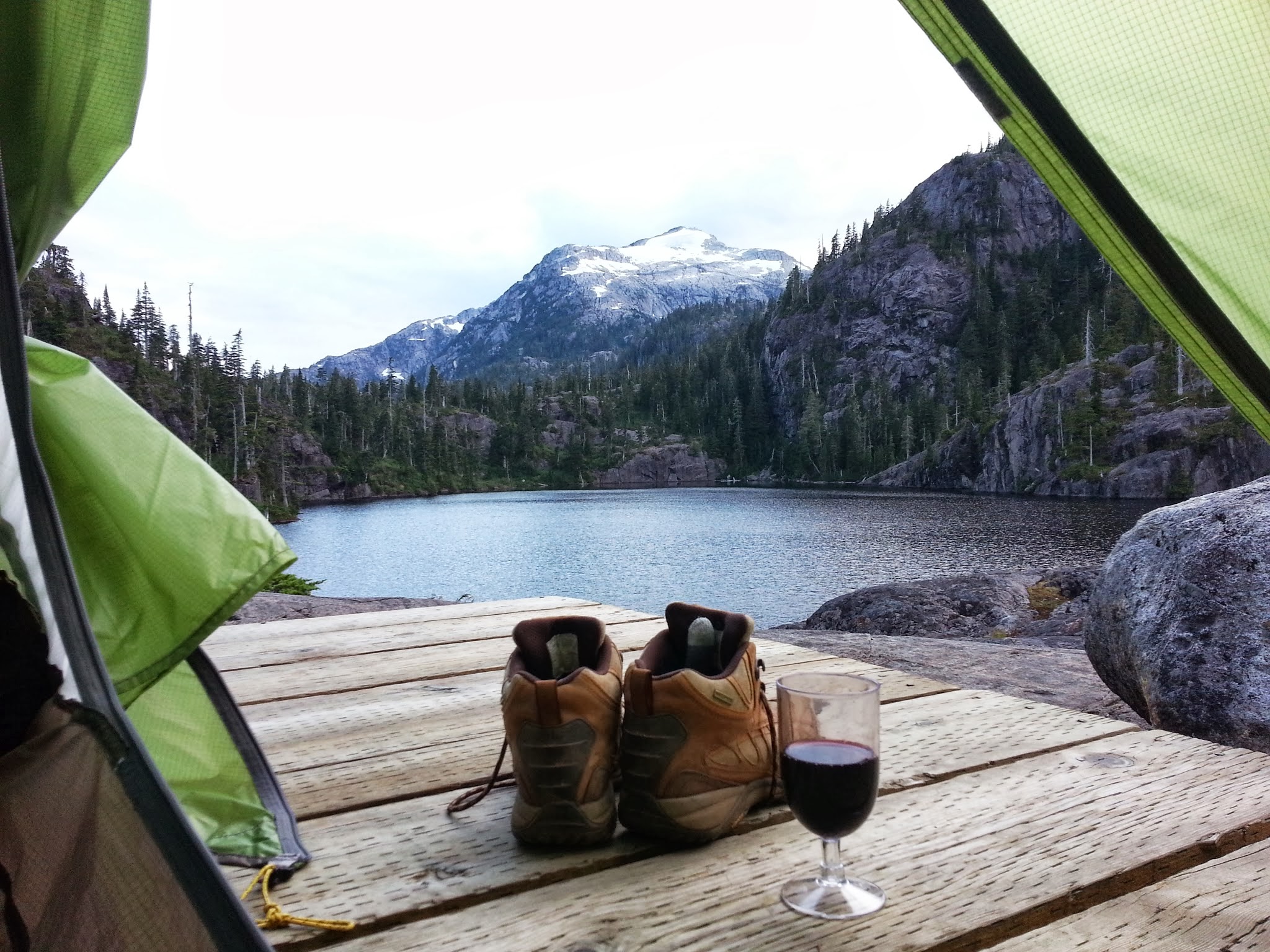
The first time I carried a loaded pack for more than an hour, I was fine for forty minutes and then I was not fine at all. Nothing dramatic happened, no injuries and I didn’t need a rescue, so there was no story worth dining out on. My shoulders just complained, my hips complained louder, and somewhere around the halfway point to Baby Bedwell, I understood that being reasonably fit and being able to carry your life on your back for four days are two completely unrelated skills.
I had completely overpacked. I was used to packing a kayak — which is pretty forgiving weight-wise — not a backpack. We were doing a simple two-day hike to Bedwell Lake and we decided Baby Bedwell was good enough! The extra, unnecessary weight in our packs was causing strain everywhere.
That gap is the thing worth talking about, because it is the thing most training advice skips right past. Day hiking fitness does not scale. You can walk ten kilometres on a Sunday and still fall apart on day two of a multi-day trip, and it will feel like a personal failing when it is actually just physics.
The load is the whole problem
A day hike asks your legs to move your body. A multi-day hike asks them to move your body plus fifteen to twenty percent of it again, over uneven ground for several consecutive days, with tired legs and no rest day in the middle to bail you out.
So the training question is not “am I fit enough to hike.” It’s “can my body handle load, hills and repetition,” in that order.
Everything below is built around those three things.
Load: carry the weight before you need to
This is the single change that separates people who enjoy day three from people who endure it.
Start putting weight in your pack early and treat it as its own skill. Not because your legs need it, but because your shoulders, your hips, your lower back and your feet all need time to negotiate with a pack that is genuinely heavy. Water bottles work fine and you can pour them out at the top of a hill if you have overestimated yourself, which you will.
Begin somewhere modest. Five or six kilograms is a real starting point, and it will feel more real than you expect. Add a kilogram every couple of weeks, and aim to be comfortable carrying slightly more than your actual trip weight before you go. If your real pack will be fifteen kilograms, train to eighteen and the real thing will feel like a gift.
The other half of this is your feet. Blisters end more multi-day hikes than fitness does. Wear the exact boots and the exact socks you plan to use, loaded, on the terrain you plan to hike. Your feet will tell you things in week three that would have ruined day one.

Hills: down is harder than up
Uphill is a cardiovascular problem. You breathe hard, your legs burn, you slow down, you get there.
Downhill is a structural problem, and it is the one that hurts later. Every descending step is your quads and knees absorbing your weight plus your pack, hundreds of times an hour, and it is the reason people finish a big descent feeling perfectly fine and then cannot get down the stairs the following morning.
Locally, there are some good trails to use to test yourself. Mount Becher on Forbidden Plateau is an obvious one since it’s close to town. There are also hikes all around Mount Washington, including some easy overnighters to Battleship Lake and Lake Helen MacKenzie.
Train descents deliberately, with weight, and stop trying to be fast on them. Slow, controlled steps that you place rather than fall into are what you need on a rooty coastal descent in the rain anyway.
Repetition: the second day is the test
Almost nobody trains for the second day, and the second day is the entire point of a multi-day hike.
Once a month or so, do back-to-back days. A loaded hike on Saturday, then another one on Sunday on legs that already hurt. It is unglamorous, it is not fun, and it is the closest thing to an actual dress rehearsal you will get. If you can walk out the door on Sunday morning feeling stiff and grumpy and still put in a decent day, you have learned something about yourself that no amount of gym time will teach you.
The strength work worth doing
You do not need a gym membership or a program with a name. You need your legs to tolerate load and your back and core to hold a pack upright when you are tired.
Step-ups onto a bench, high enough that it is awkward. Squats. Lunges, including backwards ones, which mimic the way your leg absorbs a downhill step. Something for your back and shoulders, because a pack pulls you forward all day and your posture is what stops it. Twice a week is enough. Consistency does more here than intensity.
If you are over 40, and I am comfortably past that myself, the recovery side becomes as important as the work side. Two hard days in a row followed by a rest day beats five mediocre days. Your body adapts during the rest, not during the effort. I lost more time to ignoring that than to any injury.
A rough shape, not a program
If you have twelve weeks, spend the first four just walking with a light pack and building the habit. Spend the middle four adding hills and weight, one at a time so you know which one is causing the ache. Spend the last four doing back-to-back days and testing the exact kit you plan to carry. Then taper. Do very little in the last week, arrive rested, and let all that work show up when you need it.
If you have less time than that, cut the distance of your trip rather than the training. The mountain will still be there.
The part nobody puts in the training plan
You will be slower than you want to be. You will be passed by people twenty years older than you carrying twice the weight and looking delighted about it. On day two you will have a conversation with yourself about whether this was a good idea at all.
That is not a sign you trained badly. That is just what a multi-day hike feels like from the inside, and it is a large part of why it is worth doing. The point was never to make it easy.
A sensible note: this is what worked for me, not medical advice. If you have a knee, back or heart history worth mentioning, mention it to someone qualified before you strap twenty kilograms to yourself and walk uphill.
Leave a Reply